
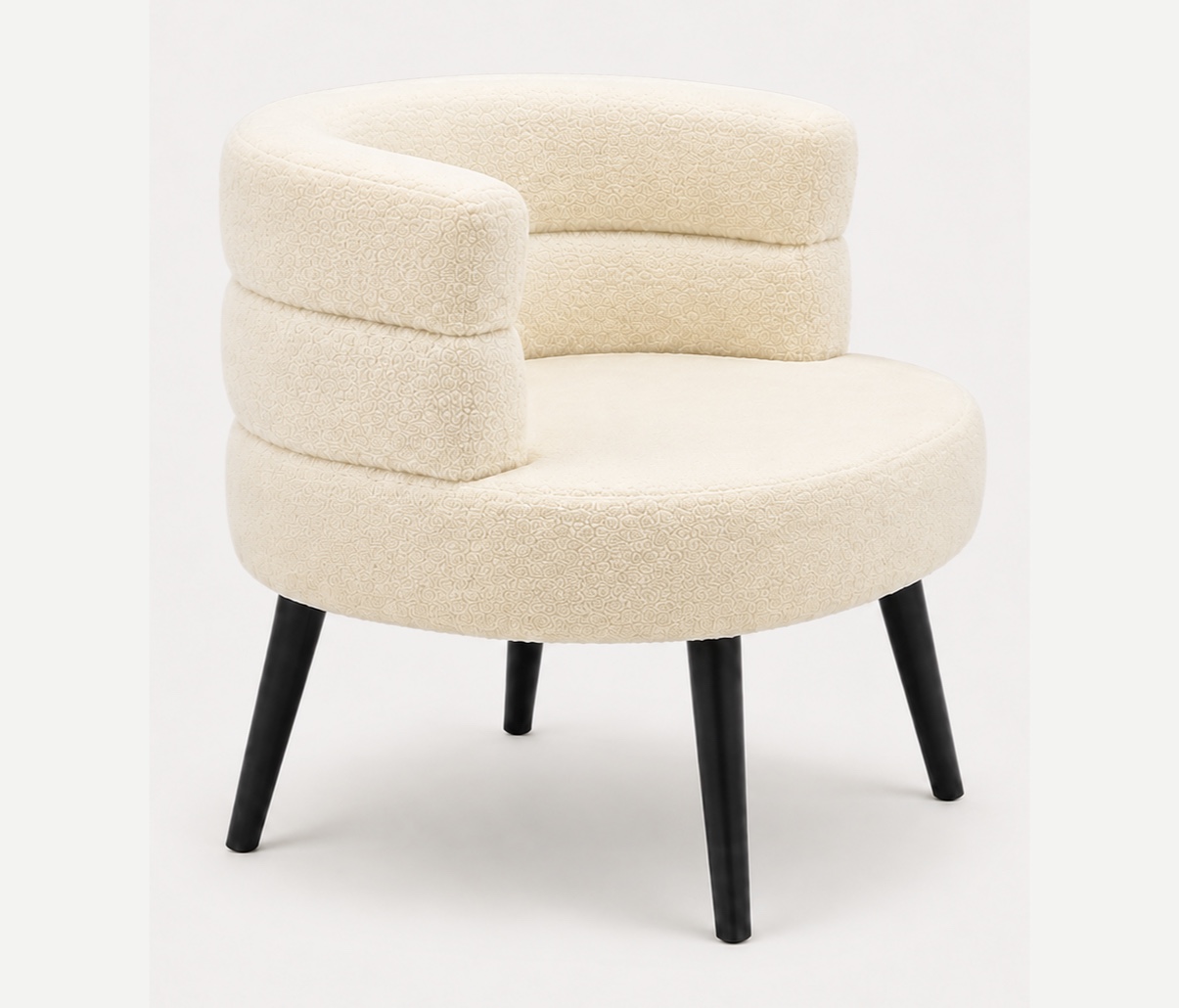
The right accent chair for a small living room fits both the available floor space and the way you sit. Begin with the chair's overall width and depth, then account for getting into the seat, opening nearby doors and moving through the room. A narrow chair with a deep recline can need more space than a wider, upright design.
Quick answer: choose a backed chair for a regular reading or conversation spot, compare the seat height with a chair you already find comfortable, and mark out the complete footprint before ordering. If you only need occasional extra seating, consider a stool separately; it serves a different purpose from a lounge chair.
In this guide: choosing the chair's job, measuring its footprint, checking seated comfort, comparing forms and finishes, and planning delivery.
Give the extra seat a clear job
Decide who will sit here and what they will do. Reading calls for somewhere to rest your arms and place a book or drink. Conversation may call for a seat angled toward the sofa. An occasional guest seat can have a different place in the room from the chair you use every evening.
Include the companion pieces in that decision. A chair, lamp and side table form a larger arrangement than the chair alone. Before adding all three, check whether an existing table is reachable and whether the lamp cable can stay out of the walking route. If the seat will face a coffee table, our coffee table size guide helps you check the surrounding arrangement.
Measure an accent chair's full footprint
Overall width includes the arms; seat width describes the usable sitting area. Overall depth includes the back and anything projecting behind it. Room & Board's printable furniture fit guide measures furniture at its widest or tallest points and recommends mapping its position in the room. Use the same distinction when reading a product drawing.
For a measuring example, imagine one chair is 80 cm wide and 85 cm deep, while another is 68 cm wide and 78 cm deep. Their rectangular footprints are 0.68 m² and approximately 0.53 m². Those are calculated examples, not Hengchi product dimensions. Neither figure includes room for your feet, a table or a route past the chair.
- Mark the overall width and depth on the floor using paper or removable tape suitable for the surface.
- Add a separate outline for a footrest, if you plan to use one.
- Open the nearest door, drawer and cupboard fully. Check their actual sweep against the outline.
- Walk the usual route with someone seated in a temporary chair at that position.
- For a reclining or rocking design, request the operating clearance and test that larger space too.
Try both a straight and an angled position. Angling a chair can change the view toward the sofa, but it can also increase the width and depth of the space it occupies. Measure the proposed position again rather than assuming a corner placement saves floor area.
Compare seat height and support
A photograph cannot tell you how the seat will feel. Record the seat height and depth of a chair you already use comfortably, and compare those measurements with the candidate. If you can try it, sit back, rest your arms and check whether the front edge or arm position feels awkward. Cushion softness can change the experience even when listed dimensions match.
Hengchi's Nappa-Finish Lounge Chair lists an approximate 43 cm seat height. That gives you one useful comparison point; it does not establish the chair's overall footprint or prove it will suit every sitter. Confirm the full dimensions and upholstery specification before deciding.
Choose between a lounge chair, footrest and stool
Start with the simplest arrangement that meets your need. A lounge chair can create a permanent place to read. A separate footrest adds another object to position and store. With the Adjustable Lounge Desk Chair with Footrest, include both pieces in your plan and ask about clearance for its adjustable backrest and rocking movement.
For an occasional extra seat, the Upholstered Cube Stool is a different option. Its listed size choices include 35 × 35 cm and 45 × 45 cm; these should not be read as seat-height measurements. It has no backrest, so assess it as occasional seating rather than assuming it can replace your main reading chair.
Consider the appearance from the doorway as well as from the sofa. Look at how much of the window, rug or adjacent furniture remains visible. Choose a finish you want to live with, then check its actual care instructions. A finish name or a product photograph alone does not establish stain resistance, leather grade or cleaning compatibility.
Check the delivery route before ordering
Measure the route from the building entrance to the final position, including narrow openings and turns. Room & Board's delivery measuring guide highlights doorways, stair landings and elevator interiors as separate checks. Compare those clearances with the packed dimensions supplied for the chair; a room-sized footprint alone cannot confirm delivery access.
Keep a short buying note: model and color, overall dimensions, seat dimensions, operating clearance, package size and assembly requirements. If any of these are missing, send Hengchi your product questions before ordering. Do not assume legs or arms can be removed unless the product instructions confirm it.
Small living room accent chair FAQs
Should I buy one accent chair or a matching pair?
Start by testing one seat in the position you will use most. A pair makes sense only if both seats remain accessible and leave the room's normal routes usable. Mark both footprints, sit in each position and check the space between them before deciding that symmetry is worth the extra furniture.
Is an armless chair always better for a small room?
No. Removing arms may reduce a particular design's width, but overall depth and back shape still matter. Compare the full dimensions of the actual chairs you are considering. Also decide whether resting your arms is part of the chair's job; saving width is not helpful if you stop using the seat.
Can I add a footrest in a compact living room?
Yes, if the layout works while the footrest is in use. Test the space occupied by the chair, your legs and the footrest together. Identify where the footrest will go when not needed, and make sure moving it there does not block another seat, a door or a cupboard.
Choose your accent chair for a small living room by matching the seat's purpose to a measured layout. Keep the footprint and delivery notes beside you when comparing options. Once those checks work, color and shape become easier decisions.