
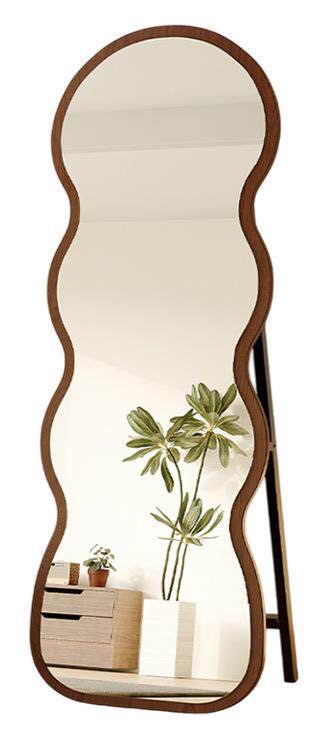
Choose a full-length mirror for a small bedroom by checking the usable reflection, the complete installed footprint, and the position where you will stand. Start beside your dressing area, confirm that doors and drawers can still open, and choose a model with an installation method suited to the room.
In this guide: viewing position, a measuring checklist, mounting options, frame choices, lighting, and common buying questions.
Start with your dressing routine
Choose a possible mirror position before comparing styles. Stand where you normally check an outfit, then open the wardrobe and bedroom door as you would when getting ready. Notice whether you have to move laundry, climb around the bed, or stand in the doorway. Try another position if it only works in a perfectly tidy room.
For a shared bedroom, repeat the exercise with someone walking past. Keep the dressing position separate from the route to the bed where possible.
Measuring for a full-length mirror in a small bedroom
Record measurements in the same unit as the product listing. Separate the mirror’s outside dimensions from its visible glass: the frame occupies space but does not contribute to your reflection. Ask for both measurements when the listing is unclear.
- Measure the available wall width and height, noting switches, sockets, skirting boards, and furniture edges.
- Mark the proposed outer frame outline with removable tape suitable for the surface. Include any curved or projecting edges.
- For a floor-supported model, obtain the installed depth, including its base or open stand. Mark that footprint on the floor.
- Measure the space between the planned mirror position and where you can comfortably stand. Record furniture that prevents you using that position.
- Open nearby doors and drawers fully. Check their paths against both the outline and any floor footprint.
- Check the product’s mounting information and visible glass dimensions before ordering. The tape outline tests fit; it cannot confirm a complete reflection.
Choose the support method before the style
A wall-mounted model can leave the floor beneath it clear, but its intended fixings and your wall construction still need to be compatible. A floor-supported model needs space for its complete support arrangement. Neither a product name nor a styled photograph tells you whether a mirror may safely stand without anchoring.
For example, IKEA permits its HOVET mirror to be wall mounted or placed on the floor, but explicitly requires wall anchoring for floor placement and notes that fasteners depend on wall material. That is a model-specific requirement, illustrating why the instructions matter. Read the IKEA HOVET installation and safety information.
For your chosen Hengchi mirror, confirm the supported installation method and required hardware. If you rent, check permission before choosing a method that requires drilling. Do not substitute an unsecured leaning arrangement for the specified installation.
Compare the frame with the usable glass
Compare frame shapes using the same available wall outline. A curved frame may be the decorative detail you want, while a straight frame may suit the lines of your wardrobe. Look at how much visible glass remains within each outline instead of choosing only by the advertised overall height.
Use the Black Frame Full-Length Mirror as one starting point, then compare its listed details with your measurements. Ask about any missing dimensions before deciding; a product photograph is not a scale drawing.
Check the reflection in daytime and at night
Mirrors can reflect light and create a sense of depth, changing how spacious a room feels; they do not increase its floor area. IKEA’s mirror guide describes these effects on perceived space and light.
Check the proposed position from the doorway and your dressing spot. Consider whether it will reflect a window, a clear wall, or an overflowing shelf. After installation, check the view again with curtains and lamps in their usual evening positions. Adjust lighting if reflected glare makes the mirror uncomfortable to use.
Questions to ask before buying
What size mirror should I choose for a small bedroom?
Choose from your available wall space, the visible glass dimensions, and the intended installation position. There is no room-size label that guarantees a useful full-length view. Compare those details with the needs of the people using the mirror, and ask the seller to clarify any missing measurements before ordering.
Is a floor mirror better than a wall mirror?
Compare their complete installed footprints and support requirements. A wall-mounted mirror may suit a narrow walkway, while a floor-supported model needs room for its base or stand. Check the instructions for the exact product: floor placement does not automatically mean the mirror can be used without wall anchoring.
Can I put a mirror behind the bedroom door?
Only consider that position after checking the full door swing, handle clearance, and access to the mirror. Do not assume a wall mirror is suitable for hanging from a door. If you want a door-mounted model, confirm that its instructions support your door and the intended fixing method.
Keep your measurement notes while browsing the Hengchi furniture collection. If a detail is missing, contact Hengchi with the product link and your measurements. The right full-length mirror for a small bedroom should fit both the room and the way you use it.